
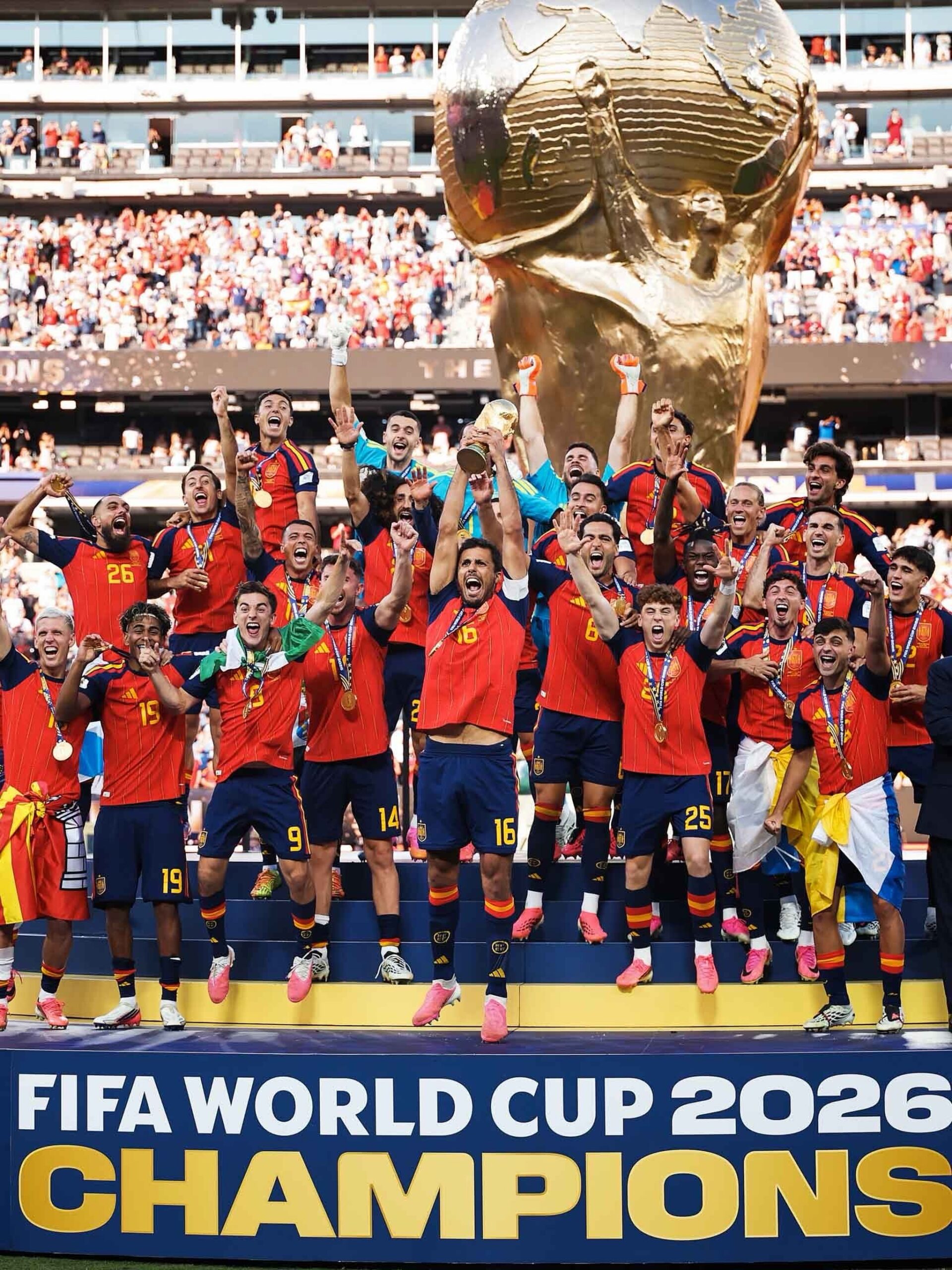
Spain celebrate their 2026 FIFA World Cup victory, lifting the trophy after defeating Argentina in the final to become world champions for the second time. Photo Credit: FIFA/Instagram
Whew! I will be one of the first to raise my hand and admit that the 2026 FIFA World Cup was a classic. Did it come with its criticisms? Of course. What we cannot say in good faith is that it didn’t deliver on the most important metrics and then some. It turned out most of the fear-mongering and scare tactics were greatly exaggerated. From an objective lens, I would say this World Cup was up there with the greats in terms of the quality of on-pitch action. I can’t say the same for the off-pitch.
Of the many talking points after-the-fact, these ones resonated more with me.
Underdog Stories
When the announcement was made that this year’s edition would comprise 48 teams, many fans weren’t particularly excited because the thinking was: while it would give opportunity to so-called smaller footballing countries to participate, the counter-argument was that the quality of matches at the World Cup might be watered down owing to the uneven pairings. Cape (Cabo) Verde takes the crown for the underdog of the tournament. Before the commencement of the World Cup, I jokingly said I would be rooting for them, but boy did they leave my jaw on the floor with their performances. Small wonder Vozinha, their 40-year-old goalie, has gained almost 30 million Instagram followers on the back of his heroics. Thinking about it, the Argentine and Spanish teams who were eventual finalists couldn’t beat these debutants in 90 minutes of regulation time – that is crazy work. Curaçao, Cape Verde, Haiti, DR Congo, Uzbekistan and Egypt have honourable mentions in the underdog group chat.
The Not-So-Subtle Rivalry Between FIFA & UEFA
Sometimes all a rift needs is a big stage to announce itself. Football, as I always say, is more politics than it is a sport. There are always competing interests in the background trying to control outcomes. After Folarin Balogun got cleared to play the next match after being shown a straight red card for a clumsy tackle in the previous match, most teams, journalists, pundits and even fans were up in arms about why the rules seemed to have been bent to accommodate a personal favour. While those opinions were valid, UEFA particularly didn’t miss an opportunity to rub it in by decrying how the game is losing its integrity. UEFA was quick to announce the appointment of the same referee who was originally selected by FIFA to officiate at the World Cup but was denied entry into one of the host countries to officiate its 2026 UEFA Super Cup next month.
African Mentality?
This year’s edition featured 10 African teams, and 9 of them made it to the next round – so there is an argument that we have improved. However, an uneasy pattern became easily recognisable. Many people called it the “86th Minute Curse”, but for me, it was simply a mentality issue. Senegal, DR Congo and Ivory Coast all choked at the 86th minute of their respective knock-out games by conceding goals. South Africa were eliminated after conceding a stoppage-time goal to one of the co-hosts, Canada. Maybe climate, lack of game management, fatigue or inexperience? It was an eyesore. I think African teams should include a behavioural psychologist if they don’t already do so because the ability to manage pressure and see a game over the line was clearly lacking.
Cultural Shock
Before arriving in the United States of America, Canada and Mexico, many fans had a certain expectation of how the countries would be, but a staggering amount of them were pleasantly surprised. Especially the Europeans, they saw badass stadiums with cutting-edge technology, free public restrooms, warehouse-sized grocery stores where almost every consumable is sold and an abundance of air-conditioning. The saying in the Lone Star State, “everything is bigger in Texas”, turns out to also apply to the rest of the country. Erling Braut Haaland famously copped a taxidermy raccoon from a Store in Dallas as a souvenir from his debut Mundial.
It wasn’t only the international visitors who were in awe; Americans also experienced other cultures. Aside from the fact that many fans saw how massive football (not soccer) actually is to the rest of the world, a city like Boston got introduced to the Tartan Army – rapid supporters of the Scottish national team. The Norwegians also took the World Cup by storm with their now-viral Viking Row. The average TV viewership for an NFL Super Bowl game is 130 million, for the NBA Finals it’s 20 million, and for the MLB, it’s about 20 million. The FIFA World Cup drew about 1.6 billion viewers; so when fans insist that it’s called football, not soccer, it’s not a culture war; the numbers back it up.
Refereeing Decisions
If we didn’t all watch the games with our own eyes, it wouldn’t be easy to agree with certain conspiracy theorists that some players or teams appear to get more favourable refereeing calls. I have a rule of thumb: whenever the actions of a referee or the officiating in general becomes a big talking point instead of the on-field action after a match, it means that was a badly officiated match. The key is consistency; when two players make similar tackles, but one gets a red card and the other walks scot-free, especially when that player is a superstar, it becomes hard to beat the allegations. Video Assistant Referee (VAR) is supposed to aid the referee, not re-litigate the match. In some cases, it helped to make the right calls, but overall there’s a lot of work to be done if fans are to fully trust match decisions.
Hydration Break Or Ad Break?
It was understandable when hydration breaks were announced for the World Cup, but fans quickly saw through the cover story because instead of visuals of players drinking water and taking instructions from the technical areas, the screens were flooded with commercials. Purists or classical football fans were not buying the spin, and I personally doubt it would be replicated for future events. The World Cup generated a record-breaking revenue north of $15 billion ahead of original projections of being in the neighbourhood of $11 billion. Once every media real estate is taken up by ads and brands seem to be shoved into the faces of the fans, the over-commercialisation will tank FIFA’s flagship product.
“General Mobutu”
Kylian Mbappé lived up to the hype as one of the stars to watch ahead of the tournament. He lit up the World Cup with his mesmerising performances and goals, but the fan-generated AI and anime videos were wild. Owing to his style of marshalling the game, not just as a star forward player but also as the captain of Les Bleus, fans christened him as the “general”. This year, they took it several notches higher by using artificial intelligence to create vignettes which told stories that involved Mbappé leading the French national team to war with their respective opponents. I have never binge-watched so many animated videos as I did with numerous “General Mobutu” videos.
The Media Is NOT Neutral
Before the World Cup, many media houses painted a very dark picture of what to expect from the event – effectively lowballing expectations. To be honest, it worked to a large extent. The vibes ahead of the games weren’t all that, but once the opening game at the Estadio Azteca in Mexico City kicked off, everything went through the roof. When I did a little research, the media outlets that ran with a certain narrative were largely from a certain region while those with counter-arguments were domiciled in another region. The subtext I could extrapolate was that some people were rooting for the event to flop because, as I said, football is not just a sport – it’s business. If you follow football, you can tell which interests have it in a chokehold. Understandably, such interests want to maintain that hegemony. Also, specific media houses have players and teams they speak more favourably of than others. So when next you think you’re listening to an “unbiased journalist”, you might really be consuming well-cooked propaganda.
Viva España!
Congratulations to La Roja on earning their second star by defeating the defending champions, Argentina, in one of the most one-sided finals we have ever seen. Spain’s dominance was anything but a fluke; it was a masterclass in tactical supremacy. As head coach, Luis De La Fuente won the European Championship in 2015, won the UEFA European Under-21 Championship in 2019 and won silver at the 2020 Tokyo Olympics. Even the mercurial Lionel Messi was subdued and couldn’t conjure any magic, especially where the competition’s golden ball winner, Rodri, was orchestrating things in the midfield. Call it prophetic, but Messi may have passed the baton to Lamine Yamal, the 19-year-old prodigy he once bathed in a charity ad as an infant. The new generation of GOATs is emerging, and for the first time in two decades, players not named Ronaldo or Messi would be headlining future World Cups. In the end, it was not a bad tournament at all. Football remains the beautiful game.
The post Mfonbong Inyang: Nine Stories That Caught My Attention From The 2026 FIFA World Cup appeared first on BellaNaija - Showcasing Africa to the world. Read today!.
from BellaNaija https://ift.tt/wikpJs4